
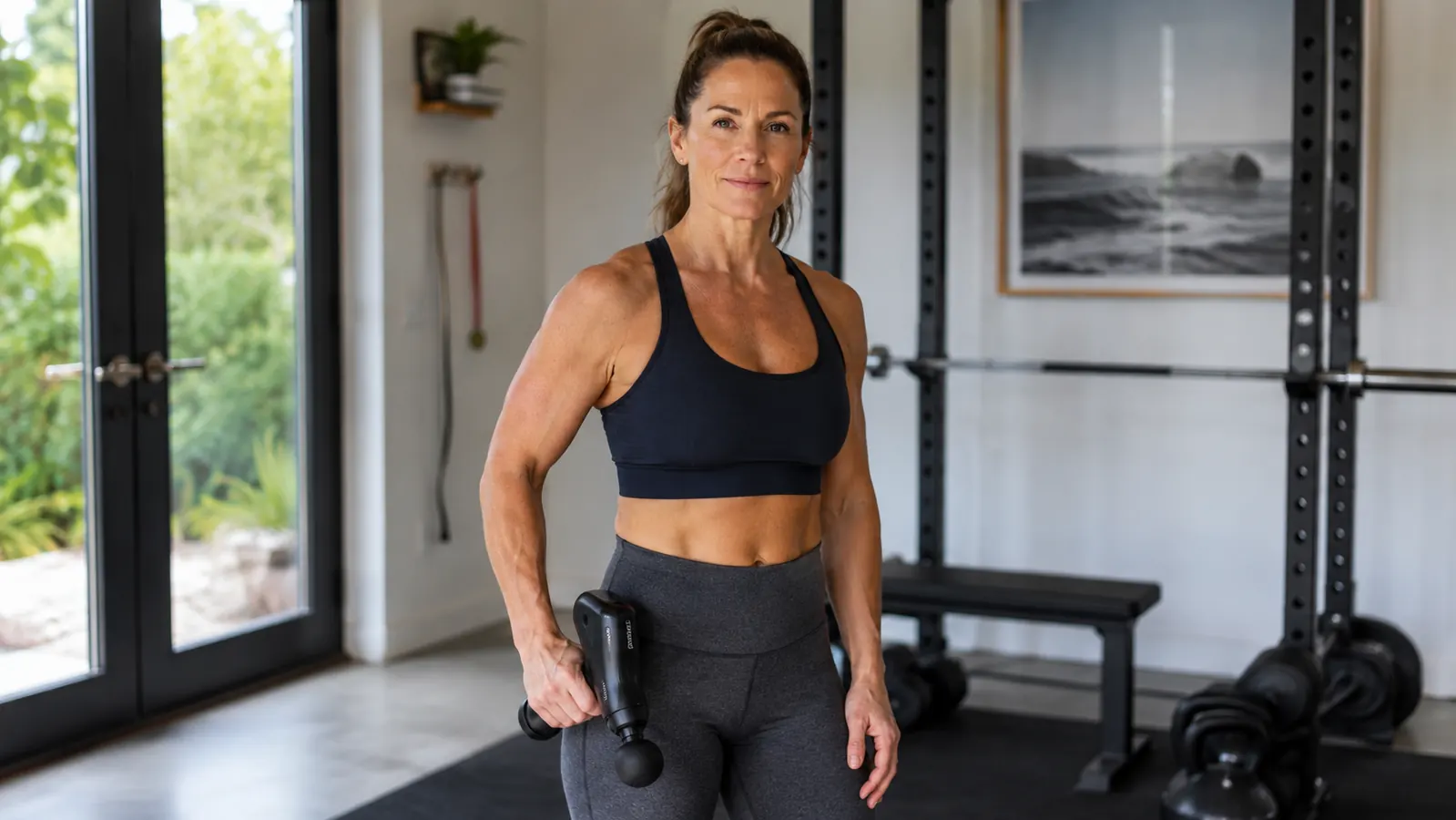
Let me tell you what the Opove M3 Pro 2 product page does not tell you. It shows beautiful photos of a sleek black device with six professional-looking attachments fanned out around it. It says battery life is 4 to 8 hours. It says the motor runs quietly. And all of that is technically true. But there is a version of the truth that lives in the fine print, and after owning this Opove for several months and watching a few people in my circle buy it and return it for the wrong reasons, I think the gaps are worth talking about.
I am Loretta. I am a realtor and a mom of six and I have been on my feet professionally for fourteen years. I have owned four percussion massagers at this point. I know what questions to ask. The Opove M3 Pro 2 is a good device, but it is a good device for a specific person, and if that person is not you, you will return it confused and write a three-star review that is not really the gun's fault.
The Quick Verdict
The Opove M3 Pro 2 earns its 4.7-star average, but the battery life claims are only accurate at low speeds, the "quiet" marketing requires some context, and four of the six attachments will live in the case forever. Buy it understanding what it actually is.
Amazon Check Today's Price →Before you guess at the price, check what Amazon is showing today.
The Opove M3 Pro 2 has been in the $100 to $130 range but the price shifts. With a 4.7-star rating from more than 20,000 real buyers, it is one of the most-reviewed massage guns in this price range. Worth a look before you commit.
Amazon Check Today's Price on Amazon →The Battery Life Claim: What 4 to 8 Hours Actually Means
The advertised range is 4 to 8 hours. That is technically accurate, but the spread is enormous and the context matters. Eight hours is what you get running the gun on speed one or two, which is a gentle vibration most people would describe as barely perceptible. Speed one is what you might use to warm up a very superficial area or if you have a very low tolerance for pressure. Most people who buy a percussion massager for actual muscle work are running it at speed three, four, or five. At speed three you are looking at roughly five hours. At speed four the battery drains noticeably faster, closer to three and a half hours. At speed five, which produces 3,200 RPM and is genuinely intense, you are probably getting two to two and a half hours before the LED starts blinking.
For daily home use, this still means charging it roughly once a week if you are doing ten to fifteen minute sessions at medium speed. That is fine and better than most guns at this price. But if you were expecting to travel for ten days and never plug it in, you will be disappointed at higher intensities. The honest advice is to charge it before every trip, not every use, and you will not run into trouble. The charging port is USB-C, which matters more than it sounds. It means you can use the same cable as your phone. I keep one cable in my gym bag and one on my nightstand and it covers both.

The Noise Level: Quiet Relative to What?
The Opove M3 Pro 2 marketing leans hard on quiet operation, and in the percussion massager world it genuinely is one of the quieter options. At speeds one and two it produces a low hum, around 45 decibels, which is roughly the ambient noise of a quiet room. You can have a phone conversation in the same room without the other person noticing. You can run it while your partner is watching TV and they will not look up. All of that is real.
But here is what the listings gloss over. At speed four and five, the Opove M3 Pro 2 is not quiet. It is not as loud as the Theragun Mini, which sounds like a dentist's drill in a coffee can, but it is loud enough that your dog will leave the room and your light sleeper in the next bedroom will hear it through the wall. The noise is a lower-frequency thump rather than a high-pitched whine, which makes it feel less aggressive, but it is absolutely present. If quiet operation matters to you, stay at speeds one through three and you are genuinely fine. If you find yourself routinely needing speed four or five, manage your expectations.
I tested this specifically one evening when my husband had already gone to sleep. On speed two with the door cracked, he did not notice. On speed four he rolled over. That is the honest noise profile. It is not a gun you can run at full power in a shared space without someone knowing.

What the Listing Photos Don't Show You
Product photos are lit and staged and shot from flattering angles. I learned this selling houses. A listing photo of an 800-square-foot kitchen makes it look like it could host a dinner party for twelve. The Opove M3 Pro 2 listing photos are tasteful and accurate in terms of the device itself, but they leave out a few things I wish I had known.
First, the actual size. The Opove M3 Pro 2 is larger than it photographs. Not unwieldy, but noticeably bigger in person than you expect from a screen. The handle is comfortable and well-designed with a rubberized grip that does not slip even when you are using it post-shower with slightly damp hands, but if you were picturing something compact enough to slide into a small bag, you should know it is solidly mid-sized. It fits in a gym bag or a carry-on easily, but it is not a mini device.
Second, the carry case. The listing shows the case closed and neat. It does not show you what happens when you try to close it after pulling everything out in a hurry. The foam cutouts are molded specifically for each attachment and the gun only fits in one orientation. If you are the kind of person who takes it out, uses it, and shoves everything back in quickly, you will spend thirty seconds every time fiddling with the case to get the lid to close. I eventually stopped packing all six attachments and just take the ball and flat head, which cuts the repack time dramatically.
The listing photos show a tidy case with everything laid out perfectly. What they don't show is what happens when you're trying to close it at 6am before your flight.
The Six Attachments: An Honest Audit
Six attachment heads sounds impressive and it looks good in a product photo. Here is the reality of which ones actually get used and which ones stay in the foam forever.
The round ball head is the one you will use 60 percent of the time. It is the right tool for large muscle groups: calves, quads, hamstrings, glutes. It disperses force over a surface area that feels therapeutic without being punishing. The flat head gets another 25 percent of the use, mainly for upper back, shoulders, and anywhere you want broader coverage. Together these two cover almost everything most people need from a massage gun.
The bullet point attachment is useful exactly once: when you have a very specific, deep knot in a small area that the ball cannot penetrate. Most people will use it two or three times total and then forget about it. The fork attachment is designed for the spine area, where the two prongs straddle the vertebrae without pressing directly on bone. I have used it maybe five times, and only when I was deliberate enough to look up the correct technique first. Without knowing how to use it, it is just a weird shape.
The cushion head is the softest option, meant for sensitive areas or people who are new to percussion massage and need a gentler introduction. If you have been using a massage gun for more than a month, you will likely never reach for this. The cone head is for targeted trigger point work on very small areas like the plantar fascia or between the shoulder blades. Again, it requires knowing what you are doing to be useful. If you are an average person recovering from everyday activity, the ball and flat head are your tools. The other four are there for the instruction booklet and the product photo.

Who Returns This Gun and Why They Get It Wrong
I have now watched three people in my orbit buy the Opove M3 Pro 2 and two of them returned it. Both returns were for reasons I think were misdiagnosed. The first person returned it saying the battery life was disappointing. She was using it exclusively on speed five. At that intensity the battery runs closer to two and a half hours of total runtime, which spread across daily fifteen-minute sessions is still more than a week. But because she expected eight hours and saw the indicator drop visibly after a few sessions, she concluded it was defective. It was not defective. It was being used at maximum output.
The second person returned it because it felt too big and heavy. She wanted something she could carry in her purse. The Opove M3 Pro 2 weighs around 2.1 pounds with the attachment. That is not heavy in any practical sense, but it is not a compact device. If you want a massage gun that lives in a small handbag, this is not the right purchase. The Theragun Mini is closer to what she wanted, though it comes with its own tradeoffs that I cover in my full Opove M3 Pro 2 vs Theragun Mini comparison.
The pattern I see in one-star and two-star reviews for this product generally falls into two categories: people who expected a pocket device and got a mid-sized one, and people who ran it at maximum speed continuously and blamed the battery. Neither of those is a product flaw. They are expectation mismatches that a more honest listing would prevent.
The Stall Force Question
Stall force is the amount of pressure you can apply before the motor bogs down and slows. The Opove M3 Pro 2 is rated at 30 pounds of stall force, which puts it solidly in the mid-range category. For most everyday recovery use, this is more than sufficient. My calves and upper back have never made this gun slow down or stutter.
Where the stall force matters is if you are working on very dense, heavily developed muscle groups, think powerlifters, competitive CrossFit athletes, or people who carry significant muscle mass in their legs and need maximum pressure to feel anything. For those users, professional-grade guns from Therabody or Hyperice at double the price deliver meaningfully more stall force and will not slow down under heavy pressure. If that sounds like you, the Opove is probably not your ceiling. If you are a busy adult recovering from normal human activity, thirty pounds of stall force is not a limitation you will ever encounter.
What I Liked
- Genuinely quiet at speeds one through three, usable in shared spaces without disturbing others
- USB-C charging means one less cable to manage on trips
- Ball and flat head attachments are excellent and cover 85 percent of practical recovery needs
- 30 pounds of stall force handles everything a recreational or working adult needs
- 4.7-star average from 20,000-plus real buyers is a meaningful quality signal
- Battery delivers roughly one week of daily use at moderate speeds before needing a charge
Where It Falls Short
- Battery drains significantly faster at speed four and five than the advertised range suggests
- Gets noticeably louder at higher speeds, quiet marketing applies mainly to the lower half of the range
- Larger in person than the listing photos convey, not a compact device
- Four of the six attachments require specific technique knowledge to be useful; most users will ignore them
- Carry case foam cutouts are snug and take time to repack correctly
What I Would Tell Someone Who Is Deciding Right Now
If you are on your feet for work, recovering from recreational exercise, or managing the kind of chronic low-grade soreness that comes from a busy life rather than elite training, the Opove M3 Pro 2 is a good buy. It is well-built, the motor is reliable, and the core use case, moderate-intensity daily recovery work, is exactly what it is designed for.
What it is not is a professional-grade tool for maximum-intensity work. It is not a pocket device. It is not eight hours of battery at full speed. If any of those three things were what you were buying it for, you need to recalibrate or look at a different category entirely. The gap between expectation and reality is where the negative reviews live, and in my opinion most of those negative reviews are not the gun's fault. They are a listing that leads with the best-case numbers and lets the buyer fill in the rest. This article is meant to fill in the rest for you before you click buy.
For the people this gun is actually designed for, and I count myself firmly in that group, it earns the rating it has. It holds up. The core functions work. And if you want to understand what you are actually getting from percussion therapy before you commit, read my full Opove M3 Pro 2 review where I walk through the detailed day-by-day experience over an extended period.

Who This Is For
Busy adults in the 35 to 55 range who need a reliable recovery tool for everyday soreness. People who travel and want something that charges from a standard USB-C cable and lasts a week at moderate use. Anyone who works standing up or on their feet and needs ten to fifteen minutes of targeted relief at the end of the day. People who have used a cheap percussion massager and want to know what the step up actually feels like.
Who Should Skip It
Anyone who needs maximum stall force for very dense, heavily developed muscle groups. Anyone who wants a device small enough to carry in a small bag or purse daily. Anyone who plans to run it exclusively at the highest two speed settings and expects eight-hour battery life from that use pattern. And anyone who needs something under $80, because at that price point the experience is materially different and the Opove is priced accordingly.
Now you know what the listing doesn't tell you. The question is whether it's still the right fit.
The Opove M3 Pro 2 is rated 4.7 stars from more than 20,000 buyers, and it earns that if you use it for what it is actually built for. Moderate-speed daily recovery, quiet enough for shared spaces, a week of battery at normal use. Check today's price on Amazon and see if it fits your situation.
Amazon Check Today's Price on Amazon →